Welcome to the table. This is one of the most profound, worldview-altering investigations a Berean can undertake. For centuries, the Western institutional church has taught a “flattened” view of the spiritual realm: there is God, there are humans, and there is a vague concept of angelsAngels are spiritual beings created by God to serve His purposes — messengers, guardians, warriors, and worshipers who carry out His will in both the heavenly realm and the earthly world. More and demonsDemons are hostile spiritual beings opposed to God, operating under Satan’s authority. Scripture portrays them as corrupt, deceptive, and destructive, yet fully subject to Christ’s power and unable to resist His command. More.
But when we look at the raw HebrewHebrew is the ancient language of the people of Israel and the primary language in which most of the Old Testament was originally written. As a member of the Northwest Semitic language family, Hebrew contains rich layers of meaning that provide deeper insight into Scripture, biblical names, prophecy, covenant theology, and God's revelation to His people. More text, the archaeological discoveries at Qumran (the Dead Sea ScrollsDead Sea Scrolls are ancient Jewish manuscripts discovered near Qumran between 1947–1956. Dating from roughly 250 BCE to 70 CE, they include biblical books, commentaries, community rules, and writings like Enoch and Jubilees. The scrolls are the oldest known copies of the Hebrew Scriptures and provide crucial insight into Second Temple Judaism and the development of the biblical canon. More), and the historical context of the ancient Near East, the Bible reveals a highly structured, geopolitical, and dimensional hierarchy known as the Divine CouncilThe Divine Council is the heavenly assembly of sons of God who participate in YHVH’s governance of creation. Scripture reveals this council in moments where God judges, decrees, or interacts with other divine beings. More.
Let us run the diagnostic on exactly who the “gods” are, how they acquired their territory, and what happened at BabelBabel is the city where humanity united in pride to build a tower reaching the heavens. God intervened by confusing their language and scattering them across the earth, marking the origin of the nations and the fragmentation of human unity. More.
1. The Courtroom of Psalm 82
Let us begin with the exact wording of . In the KJV, it reads:
“God standeth in the congregation of the mighty; he judgeth among the gods.”
The NIV translates it:
“God presides in the great assembly; he renders judgment among the ‘gods’:”
If we look at the original HebrewHebrew is the ancient language of the people of Israel and the primary language in which most of the Old Testament was originally written. As a member of the Northwest Semitic language family, Hebrew contains rich layers of meaning that provide deeper insight into Scripture, biblical names, prophecy, covenant theology, and God's revelation to His people. More, the text is shocking.
-
“God” (ElohimElohim is a Hebrew term meaning “God” or “gods,” used in Scripture to describe Yahweh’s divine nature as well as other spiritual beings who inhabit the unseen realm. Its usage reveals both the uniqueness of Israel’s God and the reality of the spiritual world. More): The supreme Creator (YHVHYHVH is the sacred four‑letter name of God in Hebrew — the Tetragrammaton — revealing the eternal, self‑existent, covenant God of Israel. It expresses His identity as “I AM,” the One who was, who is, and who will be. More).
-
“Standeth in the congregation of the mighty” (Adat El): The assembly or council of El.
-
“He judgeth among the gods” (ElohimElohim is a Hebrew term meaning “God” or “gods,” used in Scripture to describe Yahweh’s divine nature as well as other spiritual beings who inhabit the unseen realm. Its usage reveals both the uniqueness of Israel’s God and the reality of the spiritual world. More): He renders judgment among the ElohimElohim is a Hebrew term meaning “God” or “gods,” used in Scripture to describe Yahweh’s divine nature as well as other spiritual beings who inhabit the unseen realm. Its usage reveals both the uniqueness of Israel’s God and the reality of the spiritual world. More.
The Anomaly: The verse literally reads, “ElohimElohim is a Hebrew term meaning “God” or “gods,” used in Scripture to describe Yahweh’s divine nature as well as other spiritual beings who inhabit the unseen realm. Its usage reveals both the uniqueness of Israel’s God and the reality of the spiritual world. More stands in the council of El; He judges among the elohimElohim is a Hebrew term meaning “God” or “gods,” used in Scripture to describe Yahweh’s divine nature as well as other spiritual beings who inhabit the unseen realm. Its usage reveals both the uniqueness of Israel’s God and the reality of the spiritual world. More.”
Modern religious tradition often claims that the second “elohim” refers to corrupt human judges or IsraeliteIsraelite refers to a descendant of Jacob (Israel) and a member of the covenant people chosen by God. The term emphasizes identity rooted in divine promise, covenant loyalty, and participation in God’s redemptive plan. More kings. But a Berean must look at the context of the entire Psalm.
In (KJV), God issues His sentence against these entities:
“I have said, Ye are gods [elohim]; and all of you are children of the most High. But ye shall die like men, and fall like one of the princes.”
The Logical Proof: If these “gods” were already human beings (mortal judges), it makes no logical sense for God to threaten them with the punishment, “you shall die like men.” You do not threaten a human with dying like a human. God is addressing a council of higher-dimensional, immortal beings (B’nai ElohimElohim is a Hebrew term meaning “God” or “gods,” used in Scripture to describe Yahweh’s divine nature as well as other spiritual beings who inhabit the unseen realm. Its usage reveals both the uniqueness of Israel’s God and the reality of the spiritual world. More – Sons of GodSons of God refers to spiritual beings who belong to God’s heavenly realm and serve within His divine council. In Scripture, the term describes non‑human, heavenly entities who act as watchers, messengers, and participants in God’s governance of creation. They appear in key passages such as Genesis 6, Job 1–2, and Psalm 82, revealing the structure and activity of the... More) and stripping them of their immortality. They are being demoted to mortal status.
2. The Division of the Nations: Deuteronomy 32
How did these lower elohimElohim is a Hebrew term meaning “God” or “gods,” used in Scripture to describe Yahweh’s divine nature as well as other spiritual beings who inhabit the unseen realm. Its usage reveals both the uniqueness of Israel’s God and the reality of the spiritual world. More gain jurisdiction over the earth? To understand the trial in , we must look at the inciting incident: the Tower of BabelTower of Babel refers to humanity’s unified attempt to build a city and tower reaching the heavens. God intervened by confusing their language and scattering them across the earth, marking a turning point in the story of nations and divine sovereignty. More.
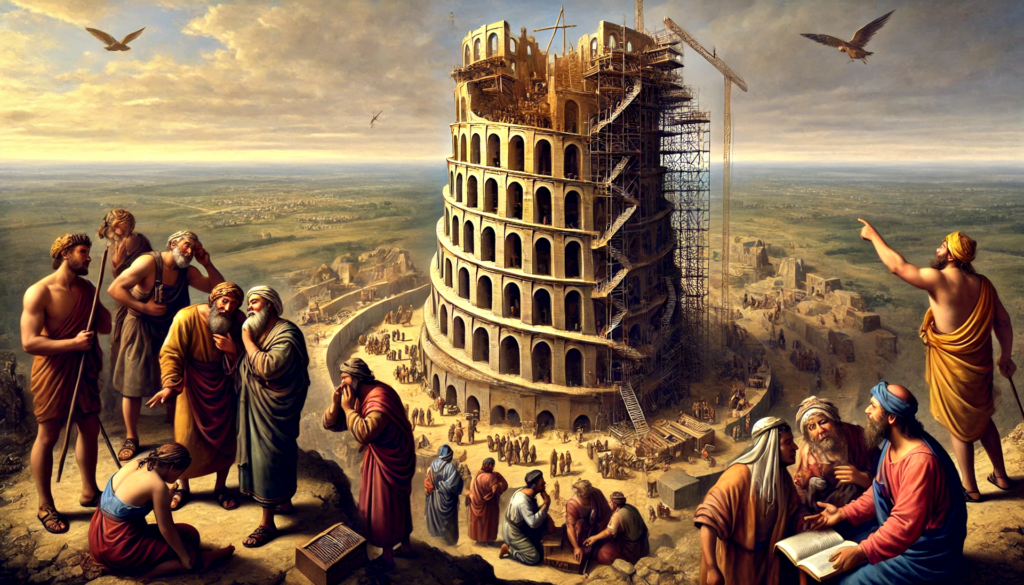
records humanity’s attempt to build a unified, technological network (a tower) to reach the heavens and make a name for themselves, bypassing the Creator’s command to scatter and fill the earth. God’s response was to confuse their language and forcefully scatter them into 70 distinct nations (the Table of Nations in ).
But reveals the spiritual logistics behind that physical scattering.
Look at in the KJV:
“When the most High divided to the nations their inheritance, when he separated the sons of Adam, he set the bounds of the people according to the number of the children of IsraelIsrael is the covenant people chosen by Yahweh, descended from Jacob, set apart to bear God’s name, receive His promises, and reveal His character to the nations. More. For the LORD’s portion is his people; JacobJacob is the third patriarch of Israel, the son of Isaac and Rebekah, whose life marks the turning point where God’s covenant promises move from a single family toward the beginnings of a nation. His story is one of struggle, transformation, and divine purpose. More is the lotLot was the nephew of Abraham and a recipient of God's mercy during the destruction of Sodom and Gomorrah. Although he chose to dwell among the wicked cities of the plain, Scripture describes him as a righteous man who was delivered by God before judgment fell upon the region (Genesis 19:16; 2 Peter 2:7-8). More of his inheritance.”
The Textual Audit (The Dead Sea ScrollsDead Sea Scrolls are ancient Jewish manuscripts discovered near Qumran between 1947–1956. Dating from roughly 250 BCE to 70 CE, they include biblical books, commentaries, community rules, and writings like Enoch and Jubilees. The scrolls are the oldest known copies of the Hebrew Scriptures and provide crucial insight into Second Temple Judaism and the development of the biblical canon. More):
Here, the Berean diagnostic requires us to audit the text. The KJV relies on the Masoretic TextMasoretic Text is the authoritative Hebrew tradition of the Old Testament preserved by Jewish scribes known as the Masoretes. Through meticulous copying, vocalization, and margin notes, they safeguarded the biblical text and shaped the form used in most modern translations. More (compiled around 900 AD), which says the nations were divided according to the “children of IsraelIsrael is the covenant people chosen by Yahweh, descended from Jacob, set apart to bear God’s name, receive His promises, and reveal His character to the nations. More.”
But there is a glaring historical and mathematical error here: When God divided the nations at BabelBabel is the city where humanity united in pride to build a tower reaching the heavens. God intervened by confusing their language and scattering them across the earth, marking the origin of the nations and the fragmentation of human unity. More, IsraelIsrael is the covenant people chosen by Yahweh, descended from Jacob, set apart to bear God’s name, receive His promises, and reveal His character to the nations. More did not exist yet. AbrahamAbraham is the first patriarch of Israel, called by God to leave his homeland and become the father of a covenant people. His life marks the beginning of God’s redemptive plan through promise, faith, and obedience. More had not even been called.
When archaeologists discovered the Dead Sea ScrollsDead Sea Scrolls are ancient Jewish manuscripts discovered near Qumran between 1947–1956. Dating from roughly 250 BCE to 70 CE, they include biblical books, commentaries, community rules, and writings like Enoch and Jubilees. The scrolls are the oldest known copies of the Hebrew Scriptures and provide crucial insight into Second Temple Judaism and the development of the biblical canon. More at Qumran in 1947 (manuscripts dating to 200 BC, over a thousand years older than the Masoretic textMasoretic Text is the authoritative Hebrew tradition of the Old Testament preserved by Jewish scribes known as the Masoretes. Through meticulous copying, vocalization, and margin notes, they safeguarded the biblical text and shaped the form used in most modern translations. More), they found the original, unedited HebrewHebrew is the ancient language of the people of Israel and the primary language in which most of the Old Testament was originally written. As a member of the Northwest Semitic language family, Hebrew contains rich layers of meaning that provide deeper insight into Scripture, biblical names, prophecy, covenant theology, and God's revelation to His people. More of .
The Dead Sea ScrollsDead Sea Scrolls are ancient Jewish manuscripts discovered near Qumran between 1947–1956. Dating from roughly 250 BCE to 70 CE, they include biblical books, commentaries, community rules, and writings like Enoch and Jubilees. The scrolls are the oldest known copies of the Hebrew Scriptures and provide crucial insight into Second Temple Judaism and the development of the biblical canon. More (and the ancient Greek SeptuagintSeptuagint (LXX) is the ancient Greek translation of the Hebrew Scriptures, produced in the centuries before Christ. It preserves early Hebrew readings, shaped Jewish worship in the Greek‑speaking world, and became the Old Testament most often quoted by the New Testament writers. More) read:
“…he set the bounds of the peoples according to the number of the Sons of GodSons of God refers to spiritual beings who belong to God’s heavenly realm and serve within His divine council. In Scripture, the term describes non‑human, heavenly entities who act as watchers, messengers, and participants in God’s governance of creation. They appear in key passages such as Genesis 6, Job 1–2, and Psalm 82, revealing the structure and activity of the... More [B’nai Elohim].”
The Geopolitical Reality:
At BabelBabel is the city where humanity united in pride to build a tower reaching the heavens. God intervened by confusing their language and scattering them across the earth, marking the origin of the nations and the fragmentation of human unity. More, God disinherited humanity. He divided the 70 nations70 Nations refers to the seventy descendants of Noah listed in Genesis 10. They represent the original families of the earth after the flood — the nations God divided and assigned boundaries to, forming the foundation of biblical cosmic geography. More and assigned each nation to the administration of a lesser spiritual entity—a “Son of God” or a territorial Watcher. God retained IsraelIsrael is the covenant people chosen by Yahweh, descended from Jacob, set apart to bear God’s name, receive His promises, and reveal His character to the nations. More (which He would later create from the DNA of AbrahamAbraham is the first patriarch of Israel, called by God to leave his homeland and become the father of a covenant people. His life marks the beginning of God’s redemptive plan through promise, faith, and obedience. More) as His own personal, direct jurisdiction ().
3. The Corrupted Administration (The Territorial Watchers)
The Lord God delegated the administration of the Gentile nations to these B’nai ElohimElohim is a Hebrew term meaning “God” or “gods,” used in Scripture to describe Yahweh’s divine nature as well as other spiritual beings who inhabit the unseen realm. Its usage reveals both the uniqueness of Israel’s God and the reality of the spiritual world. More. But just like the WatchersWatchers are high‑ranking sons of God (bene elohim) who oversee nations and realms in the biblical cosmic‑geography worldview. Some remained loyal to YHVH, while others rebelled — including the Genesis 6 Watchers who violated boundaries and produced the Nephilim. More of (who violated the biological boundaries), these territorial administrators rebelled.
Instead of governing justly and pointing the nations back to YHVHYHVH is the sacred four‑letter name of God in Hebrew — the Tetragrammaton — revealing the eternal, self‑existent, covenant God of Israel. It expresses His identity as “I AM,” the One who was, who is, and who will be. More, they demanded worship for themselves. They became the pantheons of the ancient world.
-
When the EgyptiansEgyptians are the people of ancient Egypt — a powerful civilization along the Nile known in Scripture as both neighbors and oppressors of Israel. They symbolize strength, idolatry, refuge, and judgment depending on the biblical context. More worshipped RaRa is the chief sun‑god of ancient Egypt — a powerful elohim in Egyptian religion who embodied light, kingship, and cosmic order. In the biblical worldview, Ra is one of the foreign gods whose authority is shattered when YHVH judges Egypt during the Exodus. More or Osiris…
-
When the CanaanitesCanaanites are the descendants of Canaan, son of Ham — a collection of nations inhabiting the land later promised to Israel. They represent a region under lesser elohim after Babel, marked by idolatry, fortified cities, and conflict with Israel’s covenant mission. More worshipped BaalBaal is the chief Canaanite storm‑god — a powerful territorial elohim associated with rain, fertility, and kingship. In Scripture, Baal represents idolatry, spiritual rebellion, and the counterfeit authority of fallen divine beings opposed to YHVH. More or Molech…
-
When the GreeksGreeks are the people of ancient Greece — heirs of a powerful intellectual, cultural, and religious tradition. In Scripture’s cosmic‑geography worldview, they represent one of the nations disinherited at Babel and placed under the authority of a territorial elohim, whose pantheon (Zeus, Apollo, Athena, etc.) reflects the worship of rebellious divine beings. More worshipped ZeusZeus is the chief god of the Greek pantheon — a powerful territorial elohim associated with sky, thunder, kingship, and authority. In the biblical worldview, Zeus is one of the rebellious divine beings who received the Greek nation at Babel and accepted worship that belongs only to YHVH. More or Apollo…
They were not worshipping imaginary statues. They were worshipping the literal, rebellious elohimElohim is a Hebrew term meaning “God” or “gods,” used in Scripture to describe Yahweh’s divine nature as well as other spiritual beings who inhabit the unseen realm. Its usage reveals both the uniqueness of Israel’s God and the reality of the spiritual world. More that God had assigned to those territories at BabelBabel is the city where humanity united in pride to build a tower reaching the heavens. God intervened by confusing their language and scattering them across the earth, marking the origin of the nations and the fragmentation of human unity. More.
This is precisely what God is judging in . He hauls the rebellious territorial WatchersWatchers are high‑ranking sons of God (bene elohim) who oversee nations and realms in the biblical cosmic‑geography worldview. Some remained loyal to YHVH, while others rebelled — including the Genesis 6 Watchers who violated boundaries and produced the Nephilim. More into the Divine CouncilThe Divine Council is the heavenly assembly of sons of God who participate in YHVH’s governance of creation. Scripture reveals this council in moments where God judges, decrees, or interacts with other divine beings. More courtroom and indicts them: “How long will ye judge unjustly, and accept the persons of the wicked?“ (). Because they accepted worship and ruled with corruption, God sentences them to lose their immortality and face ultimate destruction.
4. The Biblical Worldview: Cosmic Geography
When you understand the Divine CouncilThe Divine Council is the heavenly assembly of sons of God who participate in YHVH’s governance of creation. Scripture reveals this council in moments where God judges, decrees, or interacts with other divine beings. More worldview, the entire biblical database opens up. The Bible is not just a story about humans breaking moral rules; it is the documentation of a massive, multi-dimensional war for the recovery of hijacked territory.
-
Daniel 10: Why was the angel GabrielGabriel is a high‑ranking messenger of YHVH — a loyal son of God who delivers revelation, interprets visions, and announces pivotal moments in salvation history. He stands in contrast to territorial Watchers, serving directly in YHVH’s court. More delayed for 21 days when trying to deliver a message to Daniel? Because he had to physically fight the “Prince of PersiaThe Prince of Persia is a territorial elohim who resisted Gabriel’s mission to Daniel, revealing the spiritual rulers assigned to nations after Babel and the cosmic conflict behind earthly empires. More” (). This was not a human king; no human can fight an angel. It was the territorial elohimElohim is a Hebrew term meaning “God” or “gods,” used in Scripture to describe Yahweh’s divine nature as well as other spiritual beings who inhabit the unseen realm. Its usage reveals both the uniqueness of Israel’s God and the reality of the spiritual world. More assigned to the geopolitical boundary of PersiaPersia is the great empire that rose after Babylon, used by YHVH to restore Israel from exile while simultaneously revealing the unseen spiritual ruler behind its throne — the Prince of Persia. More.
-
EphesiansEphesians is Paul’s letter to the church in Ephesus, revealing Christ’s cosmic victory over spiritual powers and the believer’s identity within the new creation. It blends theology, spiritual warfare, and practical instruction for a community living in a region dominated by Artemis. More 6: When PaulPaul is the apostle who carried the message of Jesus into the Gentile world, transforming early Christianity through his missionary journeys, his letters, and his profound teaching on grace, faith, and the New Covenant. More says, “For we wrestle not against flesh and blood, but against principalities, against powers, against the rulers of the darkness of this world,” he is being literal. He is referring to the rebellious Divine CouncilThe Divine Council is the heavenly assembly of sons of God who participate in YHVH’s governance of creation. Scripture reveals this council in moments where God judges, decrees, or interacts with other divine beings. More members who currently control the Gentile nations.
Study & Memory Tool: B.A.B.E.L.
To easily recall and explain the architecture of the Divine CouncilThe Divine Council is the heavenly assembly of sons of God who participate in YHVH’s governance of creation. Scripture reveals this council in moments where God judges, decrees, or interacts with other divine beings. More and how the nations were divided, use the acronym B.A.B.E.L.
-
B – Boundaries Set: . God divided the 70 nations70 Nations refers to the seventy descendants of Noah listed in Genesis 10. They represent the original families of the earth after the flood — the nations God divided and assigned boundaries to, forming the foundation of biblical cosmic geography. More at BabelBabel is the city where humanity united in pride to build a tower reaching the heavens. God intervened by confusing their language and scattering them across the earth, marking the origin of the nations and the fragmentation of human unity. More.
-
A – Assigned to the Sons of GodSons of God refers to spiritual beings who belong to God’s heavenly realm and serve within His divine council. In Scripture, the term describes non‑human, heavenly entities who act as watchers, messengers, and participants in God’s governance of creation. They appear in key passages such as Genesis 6, Job 1–2, and Psalm 82, revealing the structure and activity of the... More: The Dead Sea ScrollsDead Sea Scrolls are ancient Jewish manuscripts discovered near Qumran between 1947–1956. Dating from roughly 250 BCE to 70 CE, they include biblical books, commentaries, community rules, and writings like Enoch and Jubilees. The scrolls are the oldest known copies of the Hebrew Scriptures and provide crucial insight into Second Temple Judaism and the development of the biblical canon. More prove the nations were assigned to the administration of the B’nai ElohimElohim is a Hebrew term meaning “God” or “gods,” used in Scripture to describe Yahweh’s divine nature as well as other spiritual beings who inhabit the unseen realm. Its usage reveals both the uniqueness of Israel’s God and the reality of the spiritual world. More (territorial WatchersWatchers are high‑ranking sons of God (bene elohim) who oversee nations and realms in the biblical cosmic‑geography worldview. Some remained loyal to YHVH, while others rebelled — including the Genesis 6 Watchers who violated boundaries and produced the Nephilim. More), not the “children of IsraelIsrael is the covenant people chosen by Yahweh, descended from Jacob, set apart to bear God’s name, receive His promises, and reveal His character to the nations. More.”
-
B – Bad Administration: . The assigned WatchersWatchers are high‑ranking sons of God (bene elohim) who oversee nations and realms in the biblical cosmic‑geography worldview. Some remained loyal to YHVH, while others rebelled — including the Genesis 6 Watchers who violated boundaries and produced the Nephilim. More rebelled, demanded worship, and ruled unjustly, becoming the paganPagan refers to the non‑Jewish, non‑Christian religious systems of the ancient world — polytheistic, idol‑centered, and rooted in nature worship, mythology, and regional deities. In Scripture, paganism represents worship directed toward created things rather than the Creator, and it forms the backdrop of Israel’s covenant struggle and the early church’s mission. More gods of the ancient world.
-
E – ElohimElohim is a Hebrew term meaning “God” or “gods,” used in Scripture to describe Yahweh’s divine nature as well as other spiritual beings who inhabit the unseen realm. Its usage reveals both the uniqueness of Israel’s God and the reality of the spiritual world. More Judged: God presides over the Divine CouncilThe Divine Council is the heavenly assembly of sons of God who participate in YHVH’s governance of creation. Scripture reveals this council in moments where God judges, decrees, or interacts with other divine beings. More (Adat El) and sentences the rebellious gods to lose their immortality (die like men).
-
L – Lord’s Portion: . YHVHYHVH is the sacred four‑letter name of God in Hebrew — the Tetragrammaton — revealing the eternal, self‑existent, covenant God of Israel. It expresses His identity as “I AM,” the One who was, who is, and who will be. More disinherited the nations but created IsraelIsrael is the covenant people chosen by Yahweh, descended from Jacob, set apart to bear God’s name, receive His promises, and reveal His character to the nations. More as His own direct, personal jurisdiction to eventually reclaim the entire earth.
This is the true cosmic geography of the scriptures. The Lord God is systematically disarming and destroying the rebellious territorial entities to reclaim the entire planet for JesusJesus of Nazareth, also called the Christ or the Messiah, is the central figure of the New Testament and the fulfillment of God’s redemptive plan. Born in the line of David, He taught with divine authority, performed miracles, and revealed the kingdom of God. More (the Last AdamThe Last Adam is a title for Jesus Christ, identifying Him as the final and decisive counterpart to the first Adam — the One who reverses the Fall, restores humanity’s purpose, and inaugurates the new creation. More).


