Welcome back to the table. We are continuing straight through the architectural and legal sequence of .
Immediately after delivering the devastating, systemic diagnostic of the teaching of “The Woes to Scribes and Pharisees,” JesusJesus of Nazareth, also called the Christ or the Messiah, is the central figure of the New Testament and the fulfillment of God’s redemptive plan. Born in the line of David, He taught with divine authority, performed miracles, and revealed the kingdom of God. More does not march away in arrogant triumph. Instead, He looks over the city of Jerusalem and utters one of the most agonizing, mathematically precise prophecies in the entire Biblical scripture.
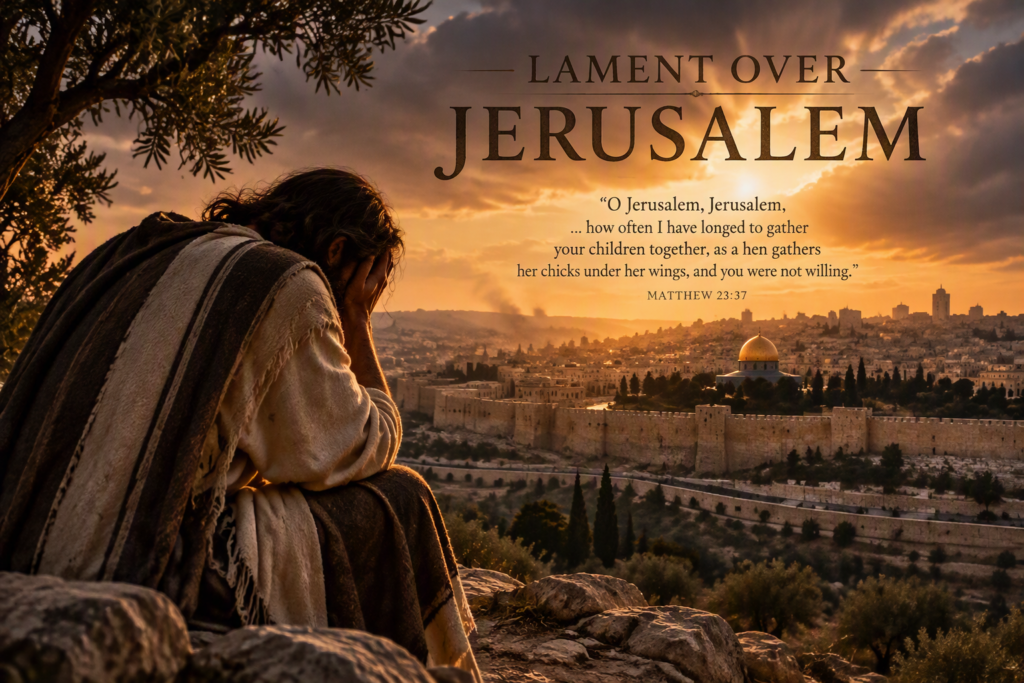
“Lament over Jerusalem”
(KJV):
“O Jerusalem, Jerusalem, thou that killest the prophetsProphets were God’s chosen messengers who spoke His word to Israel, calling the people to repentance, revealing God’s will, and announcing future events. In Scripture, “the Prophets” also refers to the second major division of the Hebrew Bible, which expands and applies the Torah’s covenant truths. More, and stonest them which are sent unto thee, how often would I have gathered thy children together, even as a hen gathereth her chickens under her wings, and ye would not! Behold, your house is left unto you desolate. For I say unto you, Ye shall not see me henceforth, till ye shall say, Blessed is he that cometh in the name of the Lord.”
Religious tradition often reads this merely as a sad goodbye. But when we apply the Berean diagnostic, we uncover a biological survival mechanism, a legal divorce of property, and a highly specific cryptographic trigger required for the “Second Coming“.
Let’s dive into the diagnostic on the Lament over Jerusalem.
1. The Biological Physics: The Heat Shield
JesusJesus of Nazareth, also called the Christ or the Messiah, is the central figure of the New Testament and the fulfillment of God’s redemptive plan. Born in the line of David, He taught with divine authority, performed miracles, and revealed the kingdom of God. More utilizes a very specific, agricultural metaphor: a hen gathering her chicks under her wings. To a modern, urban reader, this sounds like a cute, fluffy image. But to a 1st-century agrarian society, this was an image of extreme, lethal physics.
The Biological Reality: In the event of a barn fire or a predatory attack, a mother hen will call her chicks to herself. She will cover them with her wings, pulling them tightly against her body. When the fire sweeps through the barn, the hen does not flee. She remains perfectly still, physically absorbing the lethal heat and flames. After the fire, farmers will often find the charred, dead body of the mother hen—and when they lift her corpse, the chicks run out perfectly alive and unharmed.
JesusJesus of Nazareth, also called the Christ or the Messiah, is the central figure of the New Testament and the fulfillment of God’s redemptive plan. Born in the line of David, He taught with divine authority, performed miracles, and revealed the kingdom of God. More, the Last AdamThe Last Adam is a title for Jesus Christ, identifying Him as the final and decisive counterpart to the first Adam — the One who reverses the Fall, restores humanity’s purpose, and inaugurates the new creation. More, is stating His primary objective: He came to be the physical and spiritual heat shield for IsraelIsrael is the covenant people chosen by Yahweh, descended from Jacob, set apart to bear God’s name, receive His promises, and reveal His character to the nations. More. He was offering to absorb the incoming localized wrath of God and the Roman Empire into His own biological being, but they “would not“ come to Him.
The Architectural Cross-Reference: This bird imagery is not random. Where else in the biblical scripture do we see wings protecting the presence of God? Over the Mercy Seat on the Ark of the Covenant, the wings of the CherubimCherubim are powerful heavenly beings who guard sacred space, attend God’s throne, and symbolize His holiness and authority. They appear at decisive moments in Scripture, marking the boundary between God’s presence and the world. More provided the covering (). (KJV) perfectly links this physical covering to the Creator: “He shall cover thee with his feathers, and under his wings shalt thou trust.” JesusJesus of Nazareth, also called the Christ or the Messiah, is the central figure of the New Testament and the fulfillment of God’s redemptive plan. Born in the line of David, He taught with divine authority, performed miracles, and revealed the kingdom of God. More was legally offering them the ultimate dimensional covering of the Holy of Holies, and they rejected the premise he offered.
2. The Legal Divorce: “Your House”
Because they rejected the covering, JesusJesus of Nazareth, also called the Christ or the Messiah, is the central figure of the New Testament and the fulfillment of God’s redemptive plan. Born in the line of David, He taught with divine authority, performed miracles, and revealed the kingdom of God. More issues a terrifying legal decree regarding the TempleThe Temple was the permanent house of worship built in Jerusalem to replace the Tabernacle as the central place of sacrifice, prayer, and covenant worship for Israel. It served as the dwelling place of God's presence among His people and became one of the most sacred locations in biblical history. The Temple pointed forward to the coming of the Messiah,... More.
(KJV):
“Behold, your house is left unto you desolate.”
Watch the precise grammatical shift.
-
Three years earlier, when JesusJesus of Nazareth, also called the Christ or the Messiah, is the central figure of the New Testament and the fulfillment of God’s redemptive plan. Born in the line of David, He taught with divine authority, performed miracles, and revealed the kingdom of God. More cleansed the TempleThe Temple was the permanent house of worship built in Jerusalem to replace the Tabernacle as the central place of sacrifice, prayer, and covenant worship for Israel. It served as the dwelling place of God's presence among His people and became one of the most sacred locations in biblical history. The Temple pointed forward to the coming of the Messiah,... More in , He called it “My Father’s house.”
-
A few days earlier, in , He called it “My house.”
-
But now, after the religious elite completely rejected the Divine offer to cover their sins, He legally divorces Himself from the structure. He calls it “Your house.”
It is no longer the dwelling place of the Lord; it is just a pile of stones managed by unauthorized administrators.
The Archaeological Proof: When JesusJesus of Nazareth, also called the Christ or the Messiah, is the central figure of the New Testament and the fulfillment of God’s redemptive plan. Born in the line of David, He taught with divine authority, performed miracles, and revealed the kingdom of God. More says “desolate” (Greek: Eremos – a wasteland), He was setting a hard 40-year timer. In 70 AD, the Roman General Titus and the 10th Legion laid siege to Jerusalem. The Romans set fire to the TempleThe Temple was the permanent house of worship built in Jerusalem to replace the Tabernacle as the central place of sacrifice, prayer, and covenant worship for Israel. It served as the dwelling place of God's presence among His people and became one of the most sacred locations in biblical history. The Temple pointed forward to the coming of the Messiah,... More. According to historical accounts, the massive gold fixtures inside the TempleThe Temple was the permanent house of worship built in Jerusalem to replace the Tabernacle as the central place of sacrifice, prayer, and covenant worship for Israel. It served as the dwelling place of God's presence among His people and became one of the most sacred locations in biblical history. The Temple pointed forward to the coming of the Messiah,... More melted from the extreme heat and seeped into the cracks of the massive limestone foundation blocks. To recover the gold, the Roman soldiers systematically pried every single stone apart, while perfectly fulfilling Christ’s prophecy in that “there shall not be left here one stone upon another.”
Archaeologists have uncovered massive Herodian stones lying on the original first-century streets at the foot of the TempleThe Temple was the permanent house of worship built in Jerusalem to replace the Tabernacle as the central place of sacrifice, prayer, and covenant worship for Israel. It served as the dwelling place of God's presence among His people and became one of the most sacred locations in biblical history. The Temple pointed forward to the coming of the Messiah,... More Mount walls, particularly near Robinson’s Arch on the southwest corner of the “TempleThe Temple was the permanent house of worship built in Jerusalem to replace the Tabernacle as the central place of sacrifice, prayer, and covenant worship for Israel. It served as the dwelling place of God's presence among His people and became one of the most sacred locations in biblical history. The Temple pointed forward to the coming of the Messiah,... More Mount“. The stones crushed the pavement beneath them, and that damage is still visible today. Archaeologists left many of these stones in place because they provide a physical record of the Roman destruction. Excavations revealed huge blocks hurled from the TempleThe Temple was the permanent house of worship built in Jerusalem to replace the Tabernacle as the central place of sacrifice, prayer, and covenant worship for Israel. It served as the dwelling place of God's presence among His people and became one of the most sacred locations in biblical history. The Temple pointed forward to the coming of the Messiah,... More Mount onto the Herodian street below.
For someone studying prophecy, one of the most striking things is that you can literally stand on the first-century street and see the giant stones lying where Roman soldiers pushed them off nearly 2,000 years ago. It is one of the strongest physical pieces of evidence connected to the destruction JesusJesus of Nazareth, also called the Christ or the Messiah, is the central figure of the New Testament and the fulfillment of God’s redemptive plan. Born in the line of David, He taught with divine authority, performed miracles, and revealed the kingdom of God. More foretold.
3. The Cryptographic Trigger: The “Until” Clause
JesusJesus of Nazareth, also called the Christ or the Messiah, is the central figure of the New Testament and the fulfillment of God’s redemptive plan. Born in the line of David, He taught with divine authority, performed miracles, and revealed the kingdom of God. More concludes His lament with a statement that completely governs the timeline of the “end of the age“.
(KJV):
“For I say unto you, Ye shall not see me henceforth, till ye shall say, Blessed is he that cometh in the name of the Lord.”
This is not a vague prediction. This is a strictly coded, legal condition for His return. Let’s cross-reference this with the Old TestamentThe Old Testament is the first major division of the Christian Bible, containing the sacred writings of Israel — creation, covenant, law, prophecy, wisdom, and the entire pre‑Messianic history that prepares the way for Christ. More legal precedent in:
(KJV):
“I will go and return to my place, till they acknowledge their offence, and seek my face: in their affliction they will seek me early.”
The Lord returned to His place (the Ascension in ). But He bound His return to a specific, required input from the physical, genetic remnant of IsraelIsrael is the covenant people chosen by Yahweh, descended from Jacob, set apart to bear God’s name, receive His promises, and reveal His character to the nations. More. He will not set foot on the “Mount of Olives” () until the surviving Jewish remnant in Jerusalem officially requests His extraction using the exact method He provided.
The method is : “Blessed is he that cometh in the name of the LORD” (Baruch haba b’shemShem is one of Noah’s three sons and the ancestor of the peoples later associated with the Semitic line. His place in Scripture marks the continuation of God’s promise after the Flood and the beginning of the lineage that leads to Abraham and Israel. More AdonaiAdonai is the sacred Hebrew title meaning “Lord” used exclusively for God. It expresses His divine authority, sovereignty, and covenant rule. Israel used Adonai as a reverent spoken substitute for the divine name YHWH. More). During the Triumphal Entry, the crowds shouted this, but the religious elite silenced them. JesusJesus of Nazareth, also called the Christ or the Messiah, is the central figure of the New Testament and the fulfillment of God’s redemptive plan. Born in the line of David, He taught with divine authority, performed miracles, and revealed the kingdom of God. More decrees that He will remain in the higher dimensions until the official leadership of IsraelIsrael is the covenant people chosen by Yahweh, descended from Jacob, set apart to bear God’s name, receive His promises, and reveal His character to the nations. More issues this exact distress call.
In effect, the Messianic Kingdom remains in a holding pattern until the covenantal request is issued. The restoration of IsraelIsrael is the covenant people chosen by Yahweh, descended from Jacob, set apart to bear God’s name, receive His promises, and reveal His character to the nations. More, the judgment of the rebellious world system, the resurrectionResurrection is God’s act of raising the dead to new life — first seen in Christ’s victory over the grave, and ultimately fulfilled when all humanity is raised for judgment, transformation, and eternal destiny. More administration, the reign of the MessiahMessiah means “Anointed One,” the promised deliverer foretold throughout the Hebrew Scriptures. In the New Testament, Jesus is revealed as this Messiah — the fulfillment of prophecy, the bearer of God’s kingdom, and the one who accomplishes redemption through His life, death, and resurrection (Isaiah 9:6–7; Daniel 9:25; John 4:25–26). More, and the renewal of earthly governance are all held in prophetic suspension pending the authorized appeal of the surviving remnant. Once the cry of is issued from Jerusalem, the return sequence initiates, the King descends to the Mount of OlivesMount of Olives is the ridge east of Jerusalem overlooking the Temple Mount. It appears throughout Scripture as a place of worship, prophecy, and major events in Jesus’ ministry — including His ascension and His future return (2 Samuel 15:30; Zechariah 14:4; Matthew 24:3; Acts 1:9–12). More, and all remaining prophetic obligations proceed to fulfillment.
4. The Institutional Audit: The Invention of Replacement Theology
If this legal timeline is so clearly written, why do so many churches teach that God is permanently finished with the physical nation of IsraelIsrael is the covenant people chosen by Yahweh, descended from Jacob, set apart to bear God’s name, receive His promises, and reveal His character to the nations. More?
In the 2nd and 3rd centuries, Alexandrian theologians (like Origen) and later Roman church fathers (like Augustine) developed Replacement Theology (Supersessionism). When they saw the utter devastation of Jerusalem in 70 AD, they assumed God’s covenant with the physical DNA of AbrahamAbraham is the first patriarch of Israel, called by God to leave his homeland and become the father of a covenant people. His life marks the beginning of God’s redemptive plan through promise, faith, and obedience. More was permanently cancelled. They taught that the institutional Church had completely “replaced” IsraelIsrael is the covenant people chosen by Yahweh, descended from Jacob, set apart to bear God’s name, receive His promises, and reveal His character to the nations. More, inheriting all the blessings (while leaving the curses to the Jews).
But a Berean audit exposes their fatal error: They ignored the word “Till” (Until).
JesusJesus of Nazareth, also called the Christ or the Messiah, is the central figure of the New Testament and the fulfillment of God’s redemptive plan. Born in the line of David, He taught with divine authority, performed miracles, and revealed the kingdom of God. More did not say, “You will never see me again.” He set a conditional boundary. The Apostle PaulPaul is the apostle who carried the message of Jesus into the Gentile world, transforming early Christianity through his missionary journeys, his letters, and his profound teaching on grace, faith, and the New Covenant. More legally confirms this in (NIV): “IsraelIsrael is the covenant people chosen by Yahweh, descended from Jacob, set apart to bear God’s name, receive His promises, and reveal His character to the nations. More has experienced a hardening in part until the full number of the Gentiles has come in.”
The entire doctrine of Replacement Theology hinges on minimizing one prophetic word: “until.” That single word prevents Jerusalem from remaining a mere symbol and anchors prophecy to real geography, real nations, and real history. An “until” demands an ending point. It declares that Gentile control has an expiration date, that Jerusalem has a future role in God’s plan, and that Israel’s restoration is not merely spiritualized language but part of a tangible prophetic process. Remove the “until,” and prophecy becomes allegory. Preserve the “until,” and biblical prophecy remains connected to the physical world, the nations, and the unfolding timeline of redemption.
Study & Memory Tool: W.I.N.G.S.
To permanently lock this profound biological imagery, historical proof, and prophetic timeline into your memory, use the acronym W.I.N.G.S.
-
W – Wings of the CherubimCherubim are powerful heavenly beings who guard sacred space, attend God’s throne, and symbolize His holiness and authority. They appear at decisive moments in Scripture, marking the boundary between God’s presence and the world. More: . The biological metaphor of the hen was a direct offer to provide the covering of the Holy of Holies to the people.
-
I – Ichabod (The Glory Departs): The legal shift. He changes the title from “My Father’s House” to “Your house,” officially divorcing the structure.
-
N – Not One Stone: The archaeological reality of 70 AD. The Romans burned the TempleThe Temple was the permanent house of worship built in Jerusalem to replace the Tabernacle as the central place of sacrifice, prayer, and covenant worship for Israel. It served as the dwelling place of God's presence among His people and became one of the most sacred locations in biblical history. The Temple pointed forward to the coming of the Messiah,... More and pried the stones apart to extract the melted gold, leaving it Eremos (desolate).
-
G – Gathered vs. Refused: “I would have gathered… but ye would not.” The Last AdamThe Last Adam is a title for Jesus Christ, identifying Him as the final and decisive counterpart to the first Adam — the One who reverses the Fall, restores humanity’s purpose, and inaugurates the new creation. More offered to be the biological heat-shield against the wrath, but they rejected the method.
-
S – Specific Password: . The “Until” clause. He will not return until the remnant officially issues the distress call: Baruch haba b’shemShem is one of Noah’s three sons and the ancestor of the peoples later associated with the Semitic line. His place in Scripture marks the continuation of God’s promise after the Flood and the beginning of the lineage that leads to Abraham and Israel. More AdonaiAdonai is the sacred Hebrew title meaning “Lord” used exclusively for God. It expresses His divine authority, sovereignty, and covenant rule. Israel used Adonai as a reverent spoken substitute for the divine name YHWH. More.
The Lament over Jerusalem is the tragic, legal transition point of the entire biblical narrative. JesusJesus of Nazareth, also called the Christ or the Messiah, is the central figure of the New Testament and the fulfillment of God’s redemptive plan. Born in the line of David, He taught with divine authority, performed miracles, and revealed the kingdom of God. More officially closes His public ministry to the nation, turns His back on the TempleThe Temple was the permanent house of worship built in Jerusalem to replace the Tabernacle as the central place of sacrifice, prayer, and covenant worship for Israel. It served as the dwelling place of God's presence among His people and became one of the most sacred locations in biblical history. The Temple pointed forward to the coming of the Messiah,... More, and walks out.


